
Arriving in Italy is an exciting experience, but navigating a new public transport system and rushing straight into a busy sightseeing schedule can easily lead to unnecessary fatigue. Crafting a well-paced Rome arrival day itinerary from Fiumicino helps you transition smoothly into your city break. Your first day is shaped by several variables: flight delays, passport control queues for non-EU arrivals, and how easily you can reach your accommodation.
Rather than attempting to see the Vatican or the Colosseum within hours of landing, a practical first day should focus on logistics. This guide will walk you through securing a straightforward airport transfer, managing your luggage, and taking a relaxed introductory walk through the historic centre that can be adjusted based on your energy levels and arrival time.
Assessing Your Readiness to Explore
When planning your Rome arrival day itinerary from Fiumicino, it is important to distinguish between your flight’s landing time and the moment you are actually ready to explore. Navigating Fiumicino (FCO), clearing passport control, collecting baggage, and travelling into the city takes time.
For instance, if your flight lands at 10:00 AM, this serves merely as a rough planning estimate. Factoring in airport procedures and the transfer, you might realistically reach your accommodation to drop your bags around 1:00 PM, though this duration can easily fluctuate depending on queues and traffic. Furthermore, remember that standard hotel check-in times in Rome are rarely before 2:00 PM.
Instead of a rigid timetable, base your first day on when you are finally free of your luggage and ready to head out.
| Readiness State | Suggested Focus for the Day |
| Ready before noon | A complete walking route through the historic centre, incorporating a sit-down lunch and regular coffee breaks. |
| Ready mid-afternoon | A condensed walking route prioritising one or two outdoor sights, matching your remaining energy, followed by an early dinner. |
| Ready late evening | An optional short stroll near your accommodation, dinner at a nearby trattoria, and a good night’s rest. |
The Journey from Fiumicino to Rome
Selecting the right airport transfer depends heavily on where your hotel is located, how much luggage you have, and the size of your group. There is no single correct method, only the one that best suits your final destination.
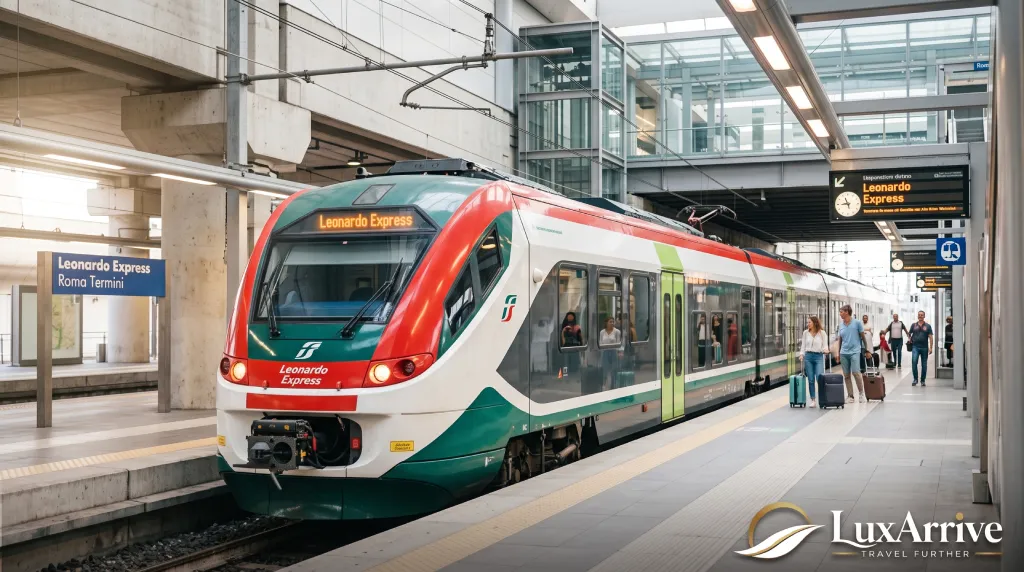
The Leonardo Express Train
For most visitors heading to the central hub of the city, the dedicated airport train is the standard choice.
- The Details: The Leonardo Express runs frequently and offers a scheduled 32-minute journey directly to Roma Termini.
- The Cost: Tickets are €14 per adult for a one-way journey.
- Practical Advice: While buying tickets online in advance saves queuing at the airport machines, ensure you check Trenitalia’s specific validity rules regarding flight delays, as terms can differ between ticket types. Furthermore, always check the schedule for the last departure on your specific date of travel. If your flight is severely delayed and you miss the final train, you will need to rely on an official night bus (such as those operated by Cotral) or a taxi.
The FL1 Regional Train
If you are staying in southern neighbourhoods such as Trastevere, Testaccio, or Ostiense, travelling all the way to Termini might take you further north than necessary. The FL1 regional train can sometimes be a more sensible alternative based on your exact address.
- The Details: The FL1 stops at Roma Trastevere, Roma Ostiense, and Roma Tiburtina.
- The Cost: At €8 for a one-way ticket, it is a highly economical option.
- Practical Advice: Reaching Roma Trastevere station does not necessarily mean you have reached your hotel. The Trastevere district is large, and from the station, you may still need to catch Tram 8 or a local bus to reach the lively pedestrian streets closer to the river.
Official City Taxis
For groups, families, or those carrying heavy bags into pedestrian-heavy areas, a taxi can simplify the journey.
- The Cost: The local transport authority sets a flat fare for official taxis travelling from Fiumicino to destinations within the Aurelian Walls (which covers most of the historic centre). As confirmed by Roma Servizi per la Mobilità, this fare is €55.00, including luggage, for up to four passengers.
- Practical Advice: Always use the official taxi rank outside the terminal and ensure the vehicle is a licensed white taxi from the “Comune di Roma”. Note that if your hotel is on a narrow, pedestrianised street, the driver will drop you at the nearest accessible point; true door-to-door service depends entirely on street access.
Navigating the “Last Mile”
If you arrive at Roma Termini, you still need to reach your accommodation. Rome is expansive, and walking 25 minutes with luggage is not recommended. You can connect to Metro Line A or Line B directly beneath Termini. A standard local public transport ticket (BIT) costs €1.50 and is valid for 100 minutes, allowing one metro journey and unlimited bus or tram transfers within that time. You can view the current network rules on the official ATAC website.
Managing Luggage Before Check-in
If you reach the city before your room is ready, dragging wheeled suitcases over traditional Roman sanpietrini (basalt cobblestones) can be a difficult endeavour.
Hotel Storage:
Contact your hotel or guesthouse beforehand to confirm if they accept early bag drops. Most traditional hotels offer this, allowing you to begin your day unburdened.
Official Left Luggage:
If you are staying in an independent apartment without a reception desk, you will need a storage service. Inside Roma Termini, you will find the official KiBag left luggage facility, which charges €10 per day for a standard suitcase. Alternatively, various app-based networks partner with local shops to store bags, with prices and conditions varying by location. Check the opening hours of your chosen facility to ensure you can retrieve your bags when your apartment is ready.

A Relaxed First-Day Walking Route
Once you are settled, a practical first day should focus on the Centro Storico (historic centre). This area is flat, atmospheric, and allows you to admire the city’s grand architecture primarily from the outside, keeping costs low and schedules flexible.
Getting to the Start of Your Tour
How you reach the beginning of this walk depends entirely on your hotel’s location. Before heading out, map the route from your accommodation to Piazza Navona. It is often best reached by local buses stopping along the main thoroughfare, Corso Vittorio Emanuele II.
1. Start at Piazza Navona
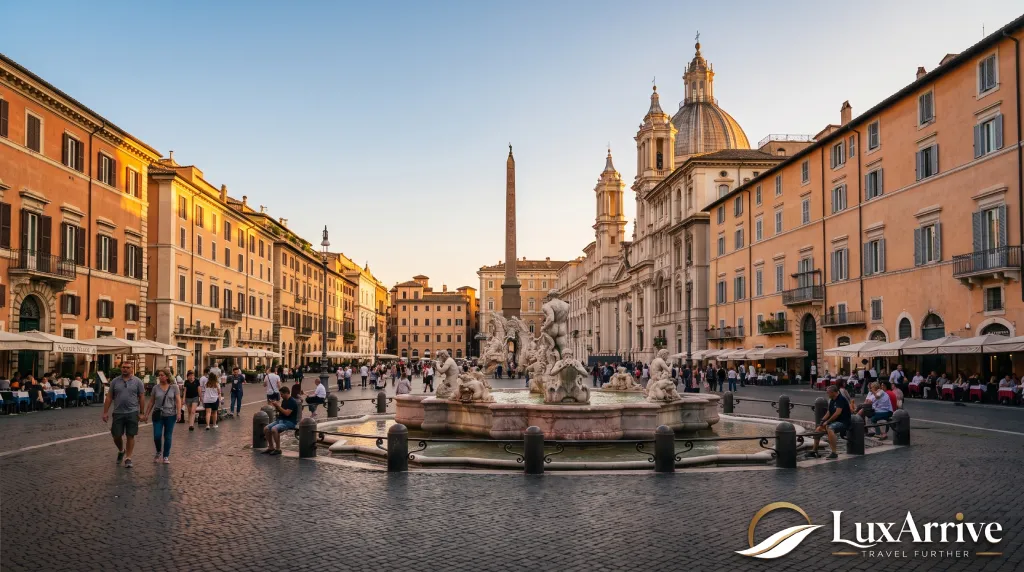
Begin your walk at Piazza Navona. Its wide, open space is an excellent spot to orient yourself and observe the pace of Roman street life. Built on the footprint of an ancient stadium, the square features three magnificent fountains, the most prominent being Bernini’s Fountain of the Four Rivers.
2. Experience Coffee Culture
From Piazza Navona, take a short stroll through the cobbled side streets towards the Pantheon. Before viewing the monument, stop for your first authentic Italian coffee. When visiting local cafés, remember that there are often two different menus: a lower price for drinking your espresso standing at the bar, and a higher price if you choose to sit at a table to rest your legs.
3. The Pantheon
Walking into Piazza della Rotonda to view the Pantheon’s massive portico is a classic Roman experience. While admiring the exterior and the accompanying fountain is free, entering the Pantheon now requires a ticket.
As of mid-2026, the entry fee is €7. You can purchase tickets via the official Musei Italiani portal, or from the on-site ticket office and self-service machines. For an arrival day, simply viewing the exterior is highly rewarding if you prefer not to spend time queuing for interior access.
4. The Trevi Fountain (Optional)
If your energy permits, continue eastward for about ten to fifteen minutes to the Trevi Fountain. It is important to note recent access changes. While you can still view and photograph the fountain for free from the surrounding piazza, accessing the inner lower walkway directly adjacent to the water now requires a €2 ticket for non-resident tourists, available via the official Fontana di Trevi website.
If the area is congested, simply admire the monument from the free outer perimeter, and treat the inner walkway as an optional activity depending on your stamina and schedule.
5. A Classic Roman Dinner
As evening approaches, avoid the restaurants immediately overlooking major monuments, as they often have higher prices. Instead, venture a few streets away into quieter alleys to find a traditional trattoria. Compare menus displayed outside and look for classic regional dishes like Cacio e Pepe or Carbonara.
Returning to Your Hotel:
Just as you planned your arrival to Piazza Navona, ensure you know which bus or metro line will take you back to your hotel from your chosen restaurant area after dinner, especially if you are staying outside the immediate historic centre.
Estimating Your First-Day Budget
The following estimate is per person and assumes a mid-afternoon start. It excludes flights, accommodation and any additional local transport needed to reach the walking route or return to your hotel.
The base budget includes €14 for the Leonardo Express—not the FL1 regional train—plus €1.50 for one local BIT ticket from Termini to your accommodation. It also allows an estimated €6–€10 for a light afternoon snack and €30–€45 for dinner. These food allowances are planning estimates, rather than fixed restaurant prices.
| Scenario | Estimated Cost Per Person |
|---|---|
| Base budget: Leonardo Express, one local BIT ticket, a light snack and dinner. | €51.50–€70.50 |
| Including all optional extras: Base budget plus €10 for luggage storage, €7 for Pantheon admission and €2 for access to the Trevi Fountain’s inner area. | €70.50–€89.50 |
Only add the extras you actually need. Leaving your bags at your accommodation and viewing the monuments from outside avoids the additional €19.
Coffee stops, purchases beyond the meal allowances and any extra bus, tram or metro journeys are not included. Allow separately for transport to Piazza Navona and back from your final stop if you will not be walking.
Five Practical Mistakes to Avoid on Your First Day
- Booking tight schedules: Avoid booking paid, non-refundable tours within hours of your scheduled landing. Flight delays or public transport adjustments can easily disrupt your plans.
- Assuming Termini is the final stop: Rome is vast. Reaching Termini station does not mean your journey is over; always map the final leg to your hotel in advance.
- Underestimating the cobblestones: If your hotel is a 20-minute walk from a station, dragging luggage over uneven sanpietrini can be exhausting. Consider a short taxi ride or local bus.
- Forgetting recent ticketing rules: Remember that both the Pantheon and the inner area of the Trevi Fountain now require paid tickets.
- Overpacking the itinerary: The desire to see everything on day one is natural, but pacing yourself ensures you have the stamina for the rest of your trip.
By securing the right transfer, managing your bags efficiently, and setting realistic expectations, your first hours in Italy will be highly enjoyable. Much like planning a Paris first day itinerary after Eurostar, your initial experience in Rome should focus on acclimatisation. If you appreciate a sensibly paced approach to European travel, you will also find excellent tips in our Paris weekend itinerary without museums for your next stress-free getaway.