If you have two full days for sightseeing -separate from your travel days- there is no need to rush. This Paris in November itinerary for 2 days focuses on comfortable pacing, logical routing, and practical ways to dodge sudden rain showers.
If you have two full days for sightseeing—separate from your travel days—there is no need to rush. This two-day Paris itinerary for November focuses on comfortable pacing, logical routing, and practical ways to dodge sudden rain showers.
If you are currently figuring out your arrival logistics, you may also find our guide on managing your first day in Paris after the Eurostar helpful. Otherwise, let’s look at how to make the most of a crisp, autumnal break in the French capital.
A Quick Look at Your 2 Days in Paris
This schedule is designed to be flexible. The timings are simply a guide to help you structure your days around the limited autumn daylight.
| Time of Day | Day 1: The Seine & Left Bank | Day 2: Palais-Royal & Passages |
| Morning | Walk the Tuileries to the Seine | Explore Palais-Royal Gardens |
| Lunch | Near Musée d’Orsay | A traditional Bouillon |
| Afternoon | Musée d’Orsay | Covered Passages (Vivienne, Panoramas, Jouffroy) |
| Evening | St-Germain-des-Prés bistrot | Optional light evening or departure |
What Changes in November?
Planning a Paris November itinerary is quite different from a summer trip. Here is what you need to consider before finalising your plans:
- Shorter Daylight Hours: The sunset shifts noticeably throughout the month. In 2026, the sun sets around 17:30 on the 1st of November, 17:15 by the 11th, and just before 17:00 by the end of the month. Schedule outdoor photography and park walks for the morning and early afternoon.
- The Weather: Temperatures drop steadily, and the air becomes noticeably chillier, especially in the evenings. Rain is common, ranging from passing drizzles to continuous grey showers.
- Wardrobe Adjustments: Layering is essential. You will be moving between chilly streets and indoor venues. Bring a reliable, compact umbrella and waterproof walking shoes—cobblestones can become slippery when wet.
Day 1: The Seine, Art, and Left Bank Comforts
This day begins outdoors to make the most of the morning light, before moving indoors for the afternoon, minimising unnecessary walking back and forth.
Morning: The Tuileries and the Seine
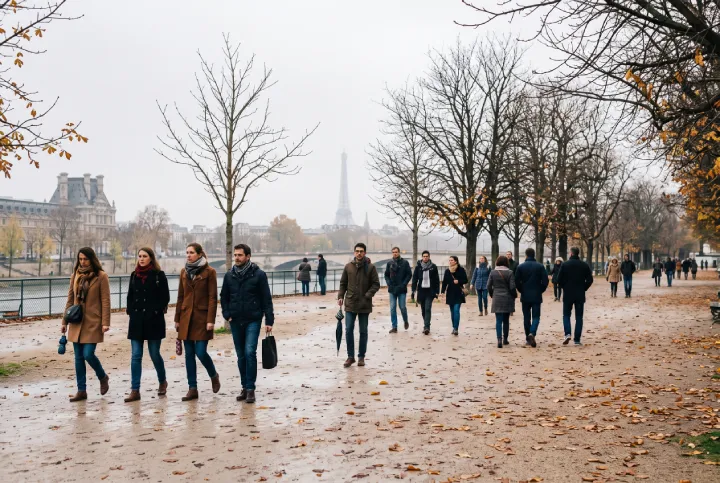
Start your day at the Jardin des Tuileries. In November, the wide gravel paths and statues take on a quiet, atmospheric quality. Walk towards the River Seine, crossing the pedestrianised Passerelle Léopold-Sédar-Senghor. This bridge offers excellent views of the Eiffel Tower in the distance and leads you directly to the Left Bank, right on the doorstep of your next stop.
Lunch: Near the Museum
Rather than walking away from the river, have lunch nearby before entering the museum for the afternoon. There are several brasseries just a short walk away along the Left Bank. A warm bowl of French onion soup is ideal for warming up.
Afternoon: Musée d’Orsay
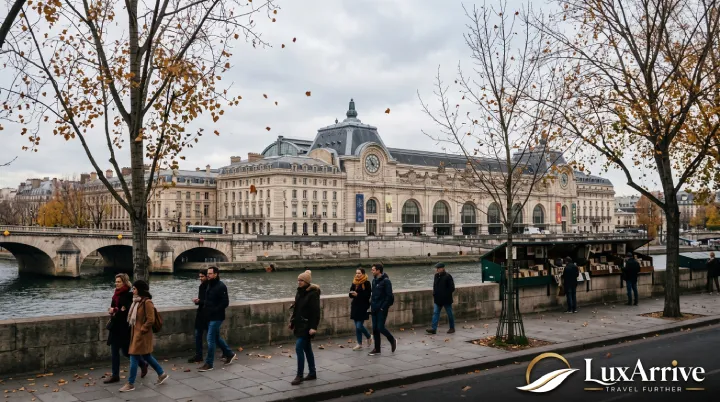
Spend your afternoon inside the Musée d’Orsay (closed on Mondays). Housed in a spectacular former railway station, it holds the world’s largest collection of Impressionist masterpieces. Spending two to three hours here is an excellent rainy-day activity in Paris, keeping you comfortable while engaging with world-class art.
Evening: St-Germain-des-Prés
After the museum, walk a short distance into the St-Germain-des-Prés neighbourhood. Keep the evening simple. Find a local bistrot for a relaxed dinner; after a day of exploring, a slow, comfortable meal in a historic quarter is a perfect finish.
Day 2: Palais-Royal and the Covered Passages
Day two focuses on the Right Bank, utilising Paris’s historic architecture to provide natural shelter from the elements.
Morning: Palais-Royal
Begin at the Domaine National du Palais-Royal. The inner courtyard features the famous striped Buren columns, while the surrounding arcades offer a sheltered walkway. It is a peaceful spot in the morning and beautiful in the soft autumn light.
Lunch and Afternoon: The Covered Passages
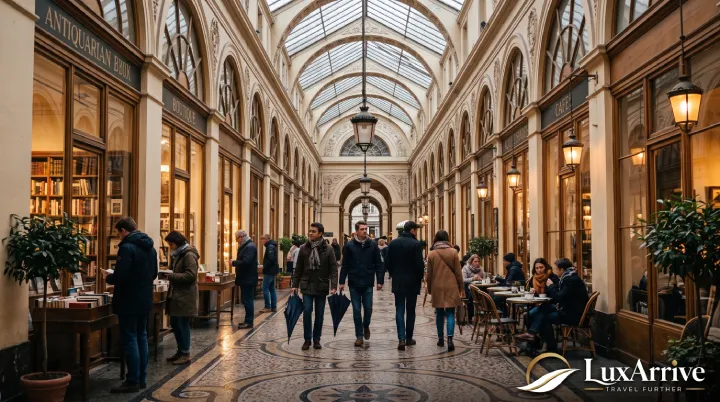
Just north of the Palais-Royal are the Passages Couverts—19th-century shopping arcades with glass roofs. They are highly practical for Paris in November on a budget, as walking through them is completely free.
Start with the elegant Galerie Vivienne, known for its mosaic floors. From there, navigate towards Passage des Panoramas. For lunch, step out briefly to the Grands Boulevards to eat at a traditional Bouillon like Bouillon Chartier – Grands Boulevards, which offers classic, affordable French fare in a bustling, historic dining room.
After lunch, continue your indoor walk through Passage Jouffroy and Passage Verdeau, taking time to browse the vintage shops, bookstores, and warm cafés.
Note: The passages do not form a single, continuous indoor route. You will need to walk along open streets for a few minutes between them, so keep your umbrella handy.
Adjusting for Rain and Closures
Flexibility is crucial in November. If you review the weather forecast and see heavy rain, be prepared to adjust.
- Swapping Days Strategically: Allocate your wettest day to Day 1 (Musée d’Orsay), as you will spend hours inside a single building. Save Day 2 (the Passages) for the drier day, as moving between the arcades requires some outdoor walking. Swapping your days entirely is strictly subject to museum opening days and whether you can secure tickets for the new date.
- Free Indoor Alternatives: If you want an indoor activity but wish to keep costs down, the Petit Palais houses the City of Paris Museum of Fine Arts. The permanent collections are entirely free. Because it is located on the Right Bank near the Champs-Élysées, you will need to adjust your walking route if you substitute it for the Musée d’Orsay. Check the calendar carefully—it is closed on Mondays and on specific public holidays, including the 11th of November.
- Pre-booked Tickets: Only book the absolute essentials ahead of time so you can adjust the rest of your day based on the weather. Always check the ticket conditions, as many advance museum tickets are timed and non-refundable.
Getting Around Paris
While Paris is walkable, November weather often dictates a shift towards public transport.
- Walking vs. The Transport Network: Walk when the weather is crisp and dry. When the rain starts, use the public transport network.
- Tickets and Fares: Paper ticket booklets are largely phased out. The most practical option is buying a physical Navigo Easy card for €2, or using a compatible smartphone to store tickets.
- Current Fares: A single Métro-Train-RER ticket costs €2.55. This is valid for transfers between the Metro, Train, and RER within a two-hour window, provided you do not exit the network. If you prefer the bus or tram, you need a separate Bus-Tram ticket for €2.05.
- Airport Exceptions: The standard Métro-Train-RER ticket does not cover entry or exit at the specific Orly and Charles de Gaulle airport stations; you must verify and purchase the correct airport route ticket for those journeys.
For more general advice on exploring the city, check out our broader Paris destination guide.
Estimated Budget for Two Days
This estimation is per person, assuming two full days of exploring. It explicitly excludes your travel from the UK (Eurostar or flights), airport transfers, and hotel accommodation.
| Category | Estimated Cost (per person) | Notes |
| Food & Drink | €110 – €140 | Roughly €55–€70 a day. A comfortable estimate for café breakfasts, casual lunches, bistrot dinners, and mentioned café breaks. Any additional orders will increase the total. |
| Transport | €17.30 – €22.40 | Based on a Navigo Easy card (€2) and 6-8 single Métro/RER journeys (€2.55 each). |
| Activities | €16 | Entry to Musée d’Orsay (standard adult online rate). The covered passages and parks are free. |
| Total Estimated | €143.30 – €178.40 | A realistic breakdown covering the mentioned meals, transport, and activities. |
Booking and Preparation Tips
To ensure your trip runs smoothly, keep these final points in mind:
- Public Holidays: France observes public holidays on the 1st of November (La Toussaint) and the 11th of November (Armistice Day). Operating hours for museums and attractions vary on these dates, so you must verify the specific schedules for your chosen venues. Banks and post offices will generally be closed.
- Advance Bookings: Book your Musée d’Orsay tickets online according to availability to secure your preferred time slot. Restaurant reservations are recommended for dinner, particularly on Friday and Saturday nights.
- Keep it Flexible: The charm of an autumn city break lies in having the time to duck into a warm café when it rains, without feeling like you are missing a scheduled appointment.
Looking for more inspiration for your European city breaks? Browse our latest travel guides for practical, grounded advice.