Choosing between Gdansk vs Wroclaw in winter for a short city break usually comes down to what you want to do when the temperature drops and the skies turn grey. Both Polish cities offer excellent value for British travellers, featuring walkable historical centres, affordable flights, and highly efficient public transport.
However, they cater to different types of winter itineraries. If you are planning a trip around the festive season or prefer spending your evenings in lively cafés and pubs, Wroclaw has a distinct advantage. If your priority is profound 20th-century history and you prefer spending long afternoons inside world-class museums, Gdansk is a remarkably strong candidate.
Before booking your flights, it is essential to understand how the harsh winter weather, shifting daylight hours, and seasonal schedules will dictate your weekend.
The Quick Verdict
When comparing the two cities, the best choice depends heavily on your exact travel dates and your specific interests.
Choose Wroclaw if you are travelling in late December or early January and want to experience a Christmas market, as Wroclaw’s market famously stays open well into the new year. It is also a fantastic option if your ideal winter break involves hopping between cosy coffee shops, admiring colourful architecture, and hunting for the city’s famous bronze dwarfs.
Choose Gdansk if you are deeply interested in history, or if you are travelling in late January or February when the festive lights have been packed away. Coastal winds can make Gdansk feel colder, but it compensates with massive, engrossing indoor museums—specifically the Museum of the Second World War and the European Solidarity Centre—where you can easily dedicate a huge portion of a cold weekend escaping the weather.
(Note: Flight routes from UK airports to Poland change seasonally. Your decision may ultimately be influenced by which city offers the most convenient direct flight from your local airport for a Friday-to-Sunday schedule).
Gdansk vs Wroclaw in Winter: At a Glance
| Feature | Gdansk | Wroclaw |
| Best For | WWII history, maritime atmosphere, huge museums | Festive markets, café culture, colourful squares |
| Winter Weather | Often feels colder due to Baltic Sea winds | Cold, but generally less biting wind |
| 2026/2027 Market Dates | 20 November – 23 December 2026 | 20 November 2026 – 7 January 2027 |
| Key Indoor Sites | Museum of WWII, Solidarity Centre | Panorama Racławicka, Hydropolis, National Museum |
| Airport to Centre | Bus 210 (4.80 PLN / ~48 mins) | Bus 106 (4.60 PLN / ~42 mins) |
| Terrain | Flat, largely cobbled in the Main City | Flat, multiple islands and bridges |
Winter Weather and Daylight
A Poland winter city break requires careful planning regarding daylight. Do not expect long afternoons of casual sightseeing throughout the entire season.
In December and early January, both cities experience only around 7.5 to 8 hours of daylight. The sun rises just before 8:00 AM and sets around 3:30 PM. However, the days begin to lengthen noticeably throughout January, with sunset pushing closer to 4:40 PM in Wroclaw by the end of the month. Always check the local sunset times for your specific dates, as early starts are often mandatory if you want to see the architecture in natural light.
Gdansk sits on the Baltic coast. While the thermometer might read a standard winter temperature of -2°C to 2°C, the coastal wind can often make the “feels like” temperature drop significantly lower. You will need a heavy windproof coat, gloves, and a hat.
Wroclaw is situated in south-western Poland. Its temperatures are remarkably similar to Gdansk on paper (frequently hovering around 0°C), but it generally lacks the biting coastal gales, making outdoor walking slightly more comfortable.
Do not book either city expecting guaranteed thick snow; modern Polish winters often feature more grey skies, frost, and occasional rain than picture-perfect snowfall.
Christmas Markets vs January and February
The timing of your weekend dramatically alters the experience.
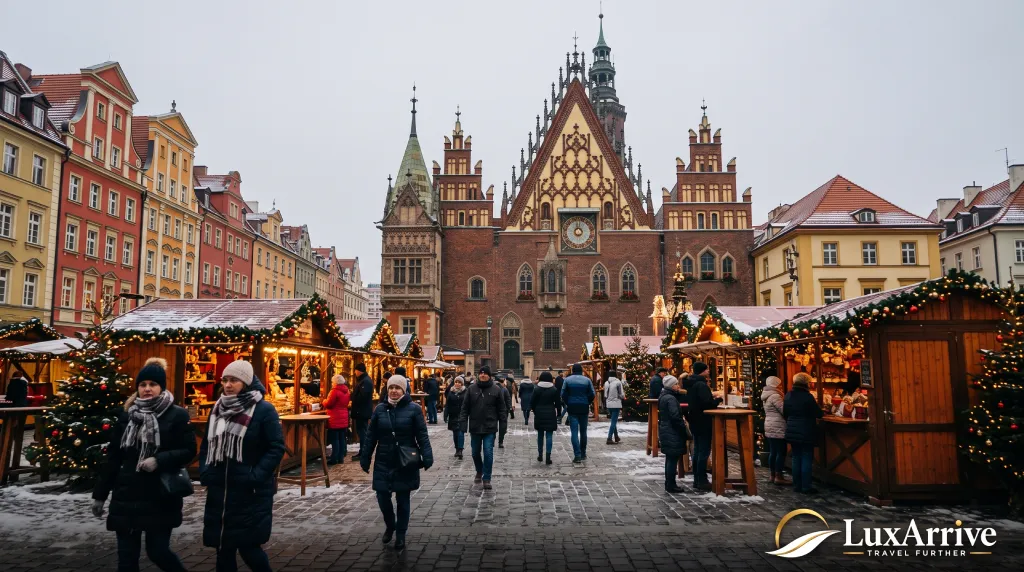
If you want a festive atmosphere, Wroclaw is widely considered to have one of the best Christmas markets in Poland, taking over the massive Market Square (Rynek) and surrounding streets. Crucially for British travellers booking breaks during the Christmas holidays, Wroclaw’s 2026/2027 market runs from 20 November right through to 7 January 2027 (note that stalls are closed on 24 and 25 December, and 1 January).
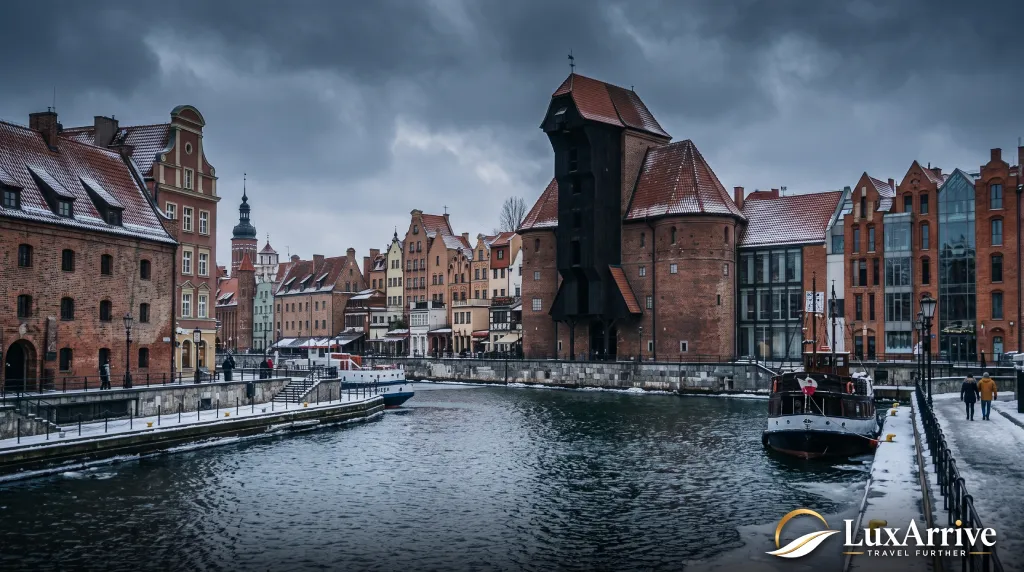
Gdansk also hosts a beautiful, albeit slightly smaller, market featuring regional amber and maritime crafts. However, the 2026 Gdansk market concludes on 23 December. If you arrive between Christmas and New Year expecting festive stalls in Gdansk, you will find that the market has already packed up.
If you are travelling in late January or February, both cities return to their standard, quieter winter routines. In these months, Gdansk remains a highly compelling choice, as its primary draw—its sprawling museums—operates year-round and remains a major attraction regardless of the festive season.
Getting There from the UK and Reaching the Centre
Both cities are served by low-cost carriers from various UK airports, and both offer incredibly cheap, straightforward public transport from the airport to the city centre. A taxi is rarely necessary.
- Gdansk (GDN): You can take the direct local Bus 210 from the terminal to the Hucisko or Dworzec Główny stops near the Main City. A single ticket costs 4.80 PLN and the journey takes roughly 45 to 50 minutes. Alternatively, the SKM train network connects the airport to the centre, though it usually requires a quick change at Wrzeszcz station and costs slightly more.
- Wroclaw (WRO): Bus 106 departs directly outside the arrivals hall and runs to the main railway station (Dworcowa). The journey takes around 35 to 45 minutes depending on traffic. A single ticket costs 4.60 PLN.
Things to Do When It Is Cold or Wet
When the weather turns poor, you need substantial indoor activities that justify the trip.
Gdansk excels here. The Museum of the Second World War (33 PLN for a standard ticket, plus an optional 12 PLN if you want the audio guide) is an architectural and curatorial masterpiece. The main exhibition is located deep underground and is so vast that it requires a minimum of three to four hours to view properly. Similarly, the European Solidarity Centre (40 PLN, audio guide included) offers a highly immersive look at the fall of communism.
Wroclaw offers a different mix. Its most famous indoor attraction is the Panorama of the Battle of Racławice (50 PLN)—a massive 19th-century panoramic painting housed in a purpose-built rotunda. You must book a timed entry slot. Other indoor options include Hydropolis (47 PLN on weekends), an interactive museum of water housed in an old reservoir.
Important note on winter closures: When planning a long weekend, keep in mind that museums often have winter closure days. In Gdansk, the Museum of the Second World War is closed on Mondays, and the ECS permanent exhibition is closed on Tuesdays from October to April. In Wroclaw, the Panorama is closed on Mondays during the winter. Always double-check holiday opening hours.
If you are expanding your search for a short winter break and realise you prefer art galleries to war history, you might also consider planning a Paris in November itinerary for 2 days instead.
Getting Around Without a Car
Neither Gdansk nor Wroclaw requires a rental car. Both are built for pedestrians and public transport.
In Wroclaw, the Old Town is highly concentrated. You will spend most of your time walking between the Rynek, Salt Square, and the beautiful Ostrów Tumski (Cathedral Island). The city is famously dotted with hundreds of small bronze dwarf statues; spotting them is an inherent part of walking around, which keeps outdoor strolls entertaining despite the cold.
In Gdansk, the reconstructed Main City (Główne Miasto)—including the Royal Way and the waterfront along the Motława River—is entirely walkable and flat. The walk to the major museums is short but exposed to the wind. Trams and buses are readily available if you wish to venture to the suburb of Oliwa.
If you are strictly opposed to winter weather but still want a highly walkable European city without a car, looking into a Porto winter weekend without a car may be a milder alternative.
Food, Cafés and Evenings
Winter travel in Poland means heavy, warming food. Pierogi (dumplings), bigos (hunter’s stew), and żurek (sour rye soup) are staples. Both cities also feature Bar Mleczny (Milk Bars)—subsidised cafeterias left over from the communist era where a hearty, no-frills lunch is very affordable.
Wroclaw feels noticeably more vibrant in the evenings. Because it is a major university city, the areas surrounding the Rynek are packed with lively pubs, craft beer bars, and atmospheric cafés that stay busy long after sunset.
Gdansk has excellent dining, particularly along the riverside and on Ulica Piwna (Beer Street), but it can feel quieter on a dark January evening compared to Wroclaw. However, Gdansk offers fantastic maritime-themed taverns and is ideal for quiet, romantic dinners in restored merchant cellars.

Which City Is Cheaper for a Winter Weekend?
Both cities are highly affordable compared to the UK, and the price difference between the two is negligible. The determining financial factor will almost always be the price of your specific flights and accommodation.
Below is a realistic, comparative budget for one adult spending two full days and two nights in the city, excluding flights and hotel.
Budget Assumptions:
- Transport: 1 return airport trip on a local bus + 2 short tram/bus journeys during the weekend.
- Food: 2 breakfasts (assuming not included in hotel, ~40 PLN each), 2 casual lunches at a Milk Bar or simple café (~40 PLN each), 2 sit-down dinners with a drink (~100 PLN each), and 2 coffee/pastry stops (~30 PLN each).
- Attractions: 2 major ticketed museums per city (WWII Museum without audio guide + Solidarity Centre in Gdansk; Panorama + Hydropolis on a weekend in Wroclaw).
- Note: Audio guides, taxis, or extra drinks are not included in this estimate.
| Expense Category (Per Person) | Gdansk Estimate (PLN) | Wroclaw Estimate (PLN) |
| Airport Return Transfer | 9.60 PLN | 9.20 PLN |
| Local Transit (2 tickets) | 9.60 PLN | 9.20 PLN |
| Food & Drink (2 Days) | 420.00 PLN | 420.00 PLN |
| Attractions (2 Paid Entries) | 73.00 PLN | 97.00 PLN |
| Total Estimated Spend | 512.20 PLN | 535.40 PLN |
(Check current exchange rates before your trip to convert the PLN totals accurately into GBP).
How to Spend Two Days in Each City
To help visualise the pace of a winter weekend with limited daylight, here are practical frameworks for both cities.
2-Day Gdansk Winter Itinerary
- Day 1: The Core and the River. Start at 9:00 AM at the Golden Gate and walk the Royal Way (Ulica Długa and Długi Targ) to the waterfront. View the medieval Crane. Have an early lunch, then head to the Museum of the Second World War at 1:00 PM. You will likely not emerge until after dark. Enjoy a hearty dinner on Ulica Piwna.
- Day 2: Solidarity and Amber. Spend your morning at the European Solidarity Centre. In the afternoon, walk down Mariacka Street (famous for its gargoyles and amber shops) and step inside the massive St Mary’s Church. Spend the dark late afternoon in a cosy café overlooking the Motława River.
2-Day Wroclaw Winter Itinerary
- Day 1: The Rynek and the Panorama. Start in the Market Square. Spend the morning hunting for the bronze dwarfs scattered around the centre. Book a midday slot for the Panorama of the Battle of Racławice. If visiting in December, spend the dark afternoon and evening eating and drinking your way through the Christmas Market.
- Day 2: Islands and Water. Walk to Ostrów Tumski (Cathedral Island). Aim to arrive just before local sunset to watch the traditional lamplighter manually ignite the real gas street lamps—a magical winter experience. Afterwards, head indoors to Hydropolis to escape the evening chill before finding a lively pub in the student quarter.
Final Verdict: Which City Should You Choose?
When deciding on Gdansk or Wroclaw for a winter break, let the calendar and your interests guide you.
Choose Wroclaw if you prefer colourful squares, cosy cafés and lively evenings. It is particularly appealing during the festive season: its 2026/2027 Christmas market runs until 7 January 2027, with closures on selected public holidays. Outside the market season, its architecture and mix of indoor attractions still offer plenty for a relaxed weekend.
Choose Gdansk if modern history and substantial museum visits are your priorities. Coastal winds can make outdoor walks feel colder, but the Museum of the Second World War and the European Solidarity Centre provide rewarding indoor options throughout the winter.
Before booking, compare direct flights from your preferred UK airport and accommodation for the same dates. The more convenient journey and better overall price may ultimately decide which city suits your weekend best.